 Skip to content
MR, chair
Honourable Members of the European Parliament,
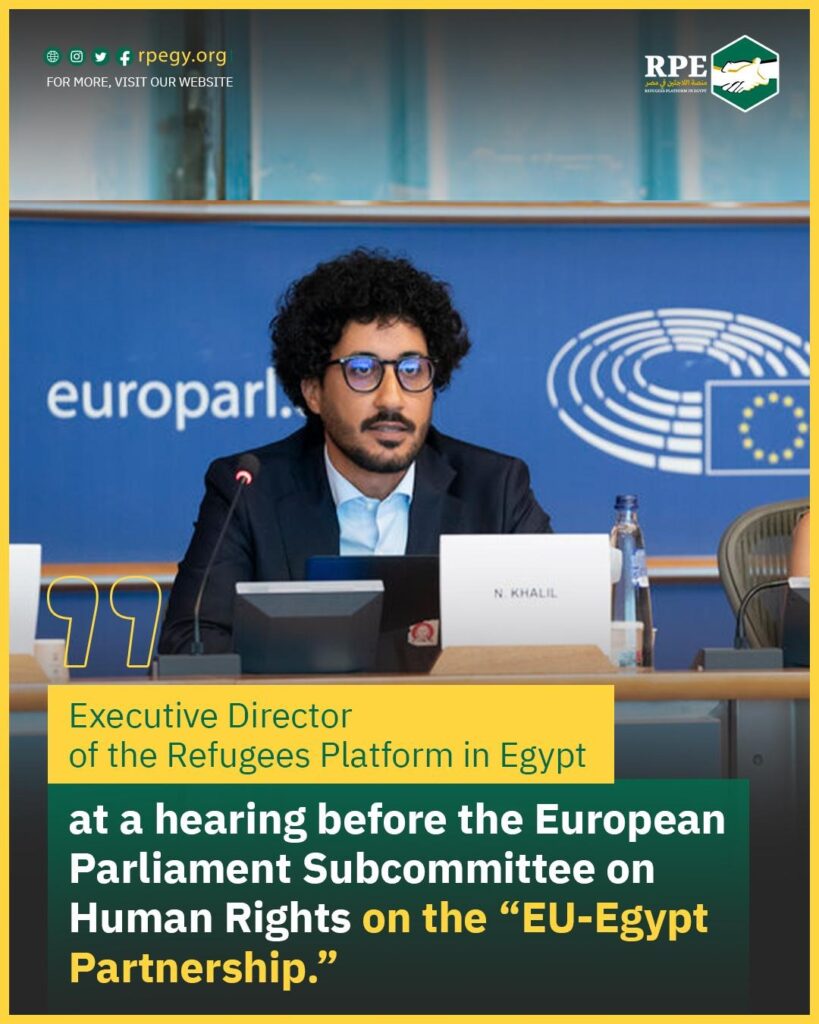
I speak to you today as an Egyptian human rights defender, with years of experience documenting the realities faced by migrants, refugees, and political prisoners in my country and the region. I address you not only as a professional, but as a witness to the human consequences of the EU’s migration externalization policies—policies that empower authoritarian regimes and deepen suffering at the borders and beyond
We are gathered to discuss the new partnership between the EU and countries like Egypt, Jordan, Tunisia, and Mauritania. But let’s not mince words: these are not migration “partnerships” — they are pacts of repression.
Lets speak about egypt- my country:
Egypt today is ruled by one of the most repressive governments in its modern history. The government of Abdel Fattah al-Sisi has filled its prisons with tens of thousands of political detainees, people are imprisoned for peaceful expression. Civil society is crushed, independent media silenced, and the judiciary weaponized.
Torture is systematic, enforced disappearances, and arbitrary detention are widespread. Yet, the EU continues to treat this regime as a “strategic partner,” pouring billions of euros into its coffers in the name of migration control.
Let me name just a few of the many silenced voices:
Alaa Abd El-Fattah, a writer and activist, has spent over a decade behind bars for his peaceful activism, enduring torture and denial of basic rights, including medical care.
Ibrahim Metwally, a lawyer and co-founder of the Families of the Disappeared, has been detained for nearly seven years, subjected to torture and inhumane conditions, while his son remains forcibly disappeared.
Hoda Abdel Moneim, a leading human rights lawyer, was sentenced to five years in prison for her work, her health deteriorating in detention, and her rights systematically denied.
This is the regime the EU is rewarding—not just with money, but with legitimacy, arms deals, and diplomatic support.
This is not just hypocrisy. It is complicity.
Egypt’s borders and the areas close to it have been militarized in recent years, impacting local communities and exposing them to risks, including death, and forced displacement( like in matrouh and orth sinai).
Migrants at the border, both Egyptian and non-Egyptian, are subjected to detention, torture, violent arrest, and, in many cases, murder. From 2016 to 2021, Egyptian authorities reported detaining 100,000 people at its borders.
For migrants and refugees, particularly from Sudan, Eritrea, Yemen, Palestine, and Syria, Egypt is not a safe haven. It is a trap.
Egyptian authorities profit thousands of euros from each single refugee trying to cross into Egypt to escape armed conflict in Sudan or genocide in Gaza, as well for syrians through privat companies connected with security agenceis.
refugees are not met with safety, but with danger. They are targeted for arrest, detention, and deportation, often to war zones, in clear violation of international law.
Recent months have seen mass round-ups in Cairo, Aswan, and other cities. Refugees with UNHCR cards are not spared; their documents are confiscated, and they are forced to sign “voluntary return” forms under coercion. Children are separated from their families, and LGBTQI+ refugees are targeted for abuse and expedited deportation.
Just in 2024 we had documented more than 20 thousand deportation, just to Sudan, the worthy humanitarian crisis in the world.
Due to recent Egyptian government decisions, refugees and asylum seekers in Egypt are denied access to basic public services such as health, education, and justice. Less than 12 percent of refugee children have access to education in Egypt.
The new Egyptian asylum law, passed without consultation, grants authorities sweeping powers to deny protection and expel refugees at will, dismantling decades of established safeguards.
The migration pact will only embolden this machinery of abuse. It will make it harder for refugees to access safety, while giving authoritarian regimes new tools to extract money and political legitimacy.
I urge you today to choose a different path.
Freeze all migration-related funding to regimes involved in systematic rights violations, including Egypt.
Condition any cooperation on strict and independent human rights monitoring — not on paper, but in practice.
Rechannel funds toward civil society, legal assistance, and community-led protection mechanisms.
Expand safe and regular pathways for migration, including humanitarian visas and family reunification
If Europe is truly serious about addressing the root causes of migration, it must abandon its policy of double standards. It must stop funding repressive regimes and turning a blind eye to financial and administrative corruption and the mismanagement of state resources for these grants and aid.
It has been proven that these regimes use these funds to consolidate political control rather than address economic and social crises. They do not solve the problem; they exacerbate it.
People do not flee in search of adventure, but rather when the doors of life are closed in their faces. If there were freedom, justice, and opportunity, no one would have to flee or take to the sea.
Funding oppression is not a solution to migration; it is one of its main causes
This pact is not inevitable. It can still be challenged. Your voice matters. Parliament must stand on the side of the people, not the regimes that silence them.
Let us not look back, years from now, and say we knew what these regimes were doing, and we chose to help them anyway.
Thank you. I’m happy to support further discussion or provide evidence.